How to Recognize a Good Fine Dining Restaurant Today: Concrete Criteria and Mistakes to Avoid
Let’s be honest for a second. The term “gastronomic restaurant” gets thrown around a lot these days. Too much, even. Between Instagram plates, TikTok hype, and menus that sound fancy just because they use French words, it’s easy to get lost. So the real question is simple : how do you actually recognize a good gastronomic restaurant today ? Not a flashy one. Not an overpriced one. A genuinely good one.
I’ve asked myself that question sitting at tiny tables, in loud dining rooms, sometimes staring at a plate that looked amazing… but tasted like nothing. And sometimes, the opposite. A discreet place, almost boring on paper, that blew my mind. One of those experiences that stick. That’s exactly why places like https://bellerive-restaurant.fr matter : no circus, just food that makes sense. Anyway. Let’s break it down, concretely.
First impression : the room talks before the plate does
 You know that feeling when you walk in and instantly relax ? Not because it’s luxurious, but because everything feels… right. Chairs you can actually sit on. Tables not glued to each other. Light that lets you see your food without feeling like you’re under a spotlight.
A good gastronomic restaurant doesn’t scream. It whispers. If the decor is trying too hard, that’s often a red flag. I’ve been in places where the marble, gold, and velvet were everywhere… and the food was flat. Honestly, I’d rather eat great food in a simple room than mediocre dishes under chandeliers.
And listen to the noise level. Can you talk without leaning in ? If you’re shouting over music at 90 decibels, something’s off.
The menu : short is usually a good sign
This is a big one. When I open a menu and see 25 dishes, I already feel tired. And suspicious. A strong gastronomic kitchen doesn’t need endless options. It needs focus.
Look for a tight, coherent menu. Maybe 4 starters, 4 mains, a couple desserts. That’s it. Seasonal ingredients mentioned clearly. Not buzzwords, but actual products. “Line-caught sea bass”, “wild mushrooms”, “farm butter”. You get the idea.
If everything is available all year round, especially ultra-seasonal stuff, I start doubting. Strawberries in January ? Yeah… no.
The service : relaxed, sharp, never robotic
This part is underestimated. Great service isn’t stiff. It’s human. The best servers I’ve met knew their dishes perfectly, but talked about them like real people. Sometimes with a smile, sometimes with a tiny hesitation. That’s good.
If the waiter can’t explain how a dish is cooked, or avoids questions, that’s not normal. At this level, they should know. Not recite. Know.
Also, timing matters. You shouldn’t wait 45 minutes between courses without explanation. But you also shouldn’t feel rushed. Gastronomy is about rhythm. Like music. Too fast or too slow, and it kills the mood.
The plate : coherence beats fireworks
Let’s talk food. Finally.
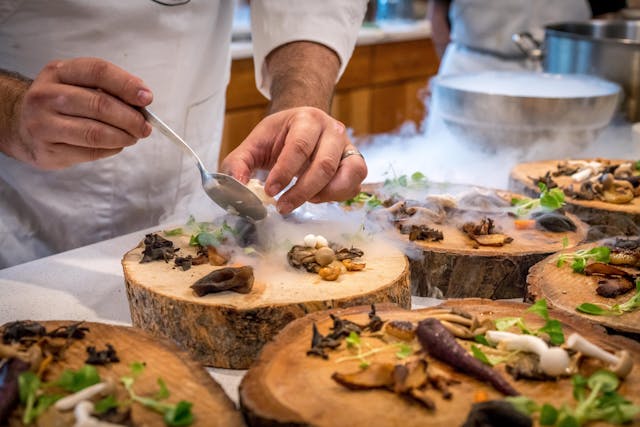
A good gastronomic dish makes sense. Everything on the plate has a reason to be there. When I see three sauces, two foams, a gel, and a flower just because… I get nervous.
Technique is important, sure. But taste comes first. Always. I don’t care how complex it was if it doesn’t hit something inside. Salt balance. Texture contrast. Temperature. That moment when you take a bite and think : “Okay. They know what they’re doing.”
And portion size ? Another tricky subject. Gastronomy doesn’t mean microscopic food. It means right-sized. You should leave satisfied, not starving, not stuffed. That balance is harder than it looks.
Consistency : the hidden marker of real quality
This is something you don’t always see on Instagram.
A truly good gastronomic restaurant is consistent. On a Tuesday night. On a Saturday full house. When the chef is there, and when he’s not. Consistency is brutal. It exposes weaknesses fast.
One amazing dish followed by two “meh” ones ? Not enough. The whole experience needs to hold up. From amuse-bouche to dessert.
Perso, I judge a place a lot on dessert. Because if they’re lazy there, it shows.
What people get wrong (very often)
Let’s clear some myths.
Price alone means nothing. I’ve paid insane amounts for meals I barely remember. And I’ve had unforgettable experiences at much more reasonable prices.
Stars aren’t everything. Michelin stars can guide you, sure. But they’re not the absolute truth. Some starless restaurants cook with more soul than starred ones. It happens. A lot.
Hype is dangerous. If a restaurant is booked solid because of social media, go with caution. Sometimes it’s deserved. Sometimes it’s just good lighting and loud marketing.
The little details that don’t lie
These are small things, but they matter.
- Warm bread, good butter. Not optional.
- Clean restrooms. Always.
- Proper wine glasses, even for water.
- A wine list that isn’t just expensive, but smart.
When a place cares about these details, it usually cares about what’s on the plate too.
So… how do you choose, concretely ?
Here’s my honest process.
I look at the menu online. I check if it changes with seasons. I read reviews, but I ignore the extremes. Too glowing or too angry, both are useless.
I pay attention to how the restaurant talks about itself. If the website is all ego and zero information, meh. If it explains its philosophy simply, that’s a good sign.
And sometimes, I just trust my gut. Because gastronomy is emotional. If a place feels right, often it is.
Final thought (and a real one)
A good gastronomic restaurant today isn’t about being impressive. It’s about being honest. Honest cooking. Honest service. Honest pricing for the work done.
If you leave thinking about a dish the next day, replaying flavors in your head… that’s it. That’s the sign.
So next time you book a table, ask yourself : do I want to be entertained, or do I want to eat something that actually matters ?
The best places already know the answer.